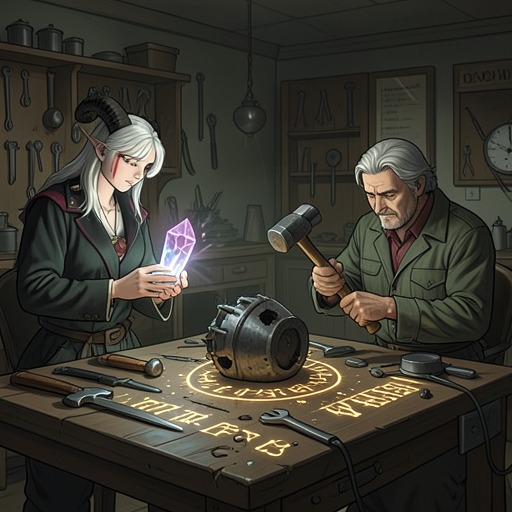
Rhek's Commission from Vivisari
New Life as a Max Level ArchmageRhek's Commission from Vivisari begins as an attempt to pull a supposedly retired master craftsman back into work and becomes a decisive test of whether an extraordinary commission can match its extraordinary promises. The Leatherworking Guild presents Rhek with a wealthy client who wants a deliberately inconspicuous set of low-level gear, allows every request, provides the materials, and wishes to collaborate. The client is Nysari Keresi, whose speed, resources, and hunting ability overturn Rhek's assumptions before the actual crafting has even begun.
The Offer and Rhek's Reluctance
Rhek has announced his retirement in terms that he considers unmistakable: no more jobs. Stellan, the Leatherworking Guild's highest-ranking intermediary, acknowledges that refusal but explains that the Guild has made an executive decision to extend the offer anyway because a particularly wealthy client requested Rhek by name. The appeal is not merely financial. Rhek is one of only three Master Leatherworkers in the human kingdoms, and his standing makes a personal request unusual enough to command attention.
Rhek initially imagines the usual commission from a rich patron: elaborate armor for a privileged noble's son, overloaded with jewels and decorative excess. He has accepted such work before because high-rank crafting consumes vast sums, especially after level fifty, when advancement requires increasingly ludicrously expensive materials and successful projects do not always recover their costs. Although he has enough money to live comfortably, he has occasionally come close to emptying his bank account through successive ill-chosen ventures. His insistence that money is not the issue therefore masks a genuine professional concern: he wants a commission worth the materials, labor, and experimentation it demands.
Stellan changes the terms by explaining that the finished product should be as unassuming as possible, something a silver-rank adventurer would wear without attracting a second glance. The level maximum is only three hundred and eighty-five. This is deeply abnormal. Master Craftsmen are generally hired for mithril-rank work at minimum and more often for orichalcum-rank projects, where their prices can be justified by equipment expected to remain useful for years or decades. Gear for a silver-ranker would normally become obsolete within a few years, sometimes within months, and a client rich enough to hire Rhek could ordinarily accelerate a lower-level career through powerful training, protection, scrolls, and consumables.
The final inducement is collaboration. Rhek's interest immediately collapses at the prospect of working with what he assumes will be a leech seeking easy advancement beside a superior craftsman. He can tolerate mentoring a guildmate, but he dislikes the prospect of a random outside collaborator even more, imagining dozens of later projects burdened by a confused helper. Stellan nevertheless secures his attention with a starting offer of nine hundred gold, unrestricted requests, and all exotic materials provided. The client also prefers locally sourced components because of their resonance, adding a technical rationale to an otherwise suspiciously generous proposal.
Nysari Keresi and the Material Test
Rhek submits an outrageous materials list almost as a provocation. He expects the Guild to take at least five days to respond, or to return with a demand that he become more reasonable. Instead, the Guild contacts him later that same day. The client has already gathered the required resources and is traveling to his workshop so that the work can begin without delay. Rhek clears his schedule and hurries out, though he does so grumpily because the speed suggests that Nysari simply purchased everything rather than harvesting it herself.
The concern matters to Rhek because the commission was presented as a pursuit of quality, not merely a shopping exercise. He assumes that most of the materials were meant to be hand-harvested, even if complete self-gathering would be impossible. Some of the requested components may not even be available in Meridian. If Nysari has failed to fulfill the list but has still summoned him to the workshop instead of revising the request, Rhek is prepared to cancel the commission and reprimand her for wasting his time.
The client is identified as Nysari Keresi, a demonic noblewoman from the Keresi family. Rhek recognizes the family name only vaguely, suggesting that it is important without being prominent enough to have fixed itself in his memory. His own workshop remains in the Crafter's District, and his supposed retirement has already been compromised by the fact that someone visits weekly to maintain it. That neglected detail reveals that he has never truly intended to abandon his life's work; the commission does not revive a dead vocation so much as expose the vocation's continued presence beneath his retirement.
When Rhek reaches the workshop, Nysari is already waiting outside and has no attendants, apprentice, or other unwanted additions with her. She is navigating a system screen when he arrives, yet her red eyes detect him well before an ordinary person could have noticed his approach, a sign of the heightened perception associated with the Titled. Rhek greets her without tact by calling her a little runt, establishing the abrasive candor that governs their first meeting. Her small appearance encourages his initial underestimation, but the materials waiting to be displayed soon make that judgment impossible to sustain.
The Unseen Reaping Shade Pelts
Nysari denies that she purchased the requested components and states that she gathered them all herself, while admitting only that she secured some upgrades during the process. To prove the point, she removes an entire, intact pearlescent shell from a Crystalback Goliabeetle. Rhek has seen perhaps five such creatures in his life, and none of the specimens had been so undamaged or so well preserved. Although the shell comes from a level-four-hundred monster and therefore has limited value as finished equipment, Crystalbacks are startlingly rare variants of Goliabeetles, which are already difficult to find and kill.
The shell is only the beginning. Nysari produces a full spindle of silk from a Cobalt Mygalom, Owlbear fat, ash from a Wyrmwood, and a growing stream of other materials that Rhek has encountered only a handful of times throughout his considerable career. The inventory display transforms the negotiation from a dispute over purchased goods into evidence of an expedition whose scale and speed he cannot explain. The commission's promised quality is no longer hypothetical; it is physically spread across his worktable.
The decisive reveal is the presence of three Unseen Reaping Shade pelts. Rhek has seen only two listings for such pelts, both through private channels that even Nysari should not have been able to access. His outrage is inseparable from astonishment: the problem is not simply that the materials are rare, but that three of them are present together, freshly harvested, and available for an ostensibly low-rank project. Nysari answers his disbelief with an understated acknowledgment that the creatures are tricky to hunt, a response that makes the feat more startling rather than less.
Rhek's own skills confirm that the pelts were harvested within the past several hours, as were the other components on the table. The freshness rules out old stock, an arranged purchase, or a staged deception. He concludes that nobody short of an upper-Titled could have accomplished the gathering, and even that comparison does not explain how it was done so quickly. His lingering doubt about whether Nysari is truly the Sorceress's daughter nearly disappears. Whatever her exact identity, she has demonstrated the capacity that the commission's strange terms implied: access to rare resources, the ability to acquire them immediately, and the power to make them available for specialized work.
The Commission's Crafting Stakes
The materials change Rhek's attitude because rare components are not merely expensive inputs; they offer a substantial experience advantage. He estimates that a successful undertaking could raise him an entire rank. Retirement has left him without much of a schedule, but the prospect of working with materials he has used only rarely reconnects him to the experimental excitement that his commercial commissions had dulled. The jewels and frippery of wealthy clients had made him nauseated, whereas Nysari's assortment offers the possibility of genuine craft rather than decorative extravagance.
Having inspected the evidence, Rhek concedes that Nysari really did hunt the materials herself. He calls the collection acceptable before correcting himself and admitting that he is impressed. The project can now become something great, provided the materials' potential survives the uncertainties of the craft. Nysari confirms that she wants a full set of mage's gear with a focus on defense.
The request itself carries a technical risk. Mages usually employ tailors rather than leatherworkers, not because heavier armor is forbidden, but because the resulting stat bonuses and manifested effects often fail to suit magical combat. The concentration of magic-type materials improves the odds that the finished equipment will support a mage, yet crafting remains partly a gamble. Rhek can guarantee durable gear; he cannot guarantee that the armor's effects will emerge in the exact configuration Nysari requires. The commission therefore ends its opening phase with an agreement to attempt an ambitious synthesis: unassuming silver-rank equipment, defensive mage utility, rare locally sourced components, and a collaboration whose value lies as much in the materials and process as in the final appearance.
Significance of the Commission
The episode reverses the normal hierarchy of a master-craftsman negotiation. Rhek begins as the gatekeeper who can reject an intrusive client, while Stellan must tempt him with wealth, rarity, and unusual terms. Once Nysari reveals the materials, however, she becomes the party whose accomplishments Rhek struggles to comprehend. Her commission does not merely purchase his labor; it supplies the rare conditions under which his own dormant ambition can return.
The contrast between the equipment's intended modest appearance and the spectacular provenance of its components defines the commission's central tension. A set of gear meant to pass unnoticed by a silver-rank adventurer is supported by a Crystalback Goliabeetle shell, Cobalt Mygalom silk, Owlbear fat, Wyrmwood ash, and three freshly harvested Unseen Reaping Shade pelts. The project thus joins concealment with excess: its visible form should be bland, but its material history is extraordinary. Rhek's movement from refusal, through suspicion, to professional excitement marks the episode's decisive change, turning an apparently pointless retirement interruption into a rare opportunity to make something genuinely remarkable.